Performance · Readiness · Wellbeing

Know where
you stand,
privately.

Private insight for people.
Earlier understanding for organisations.

My LIMEN is being built to give people meaningful benchmarks for their own progress, and organisations a protected view of how their people are doing.

Individual prototype available · Wider platform in development

Individual prototype
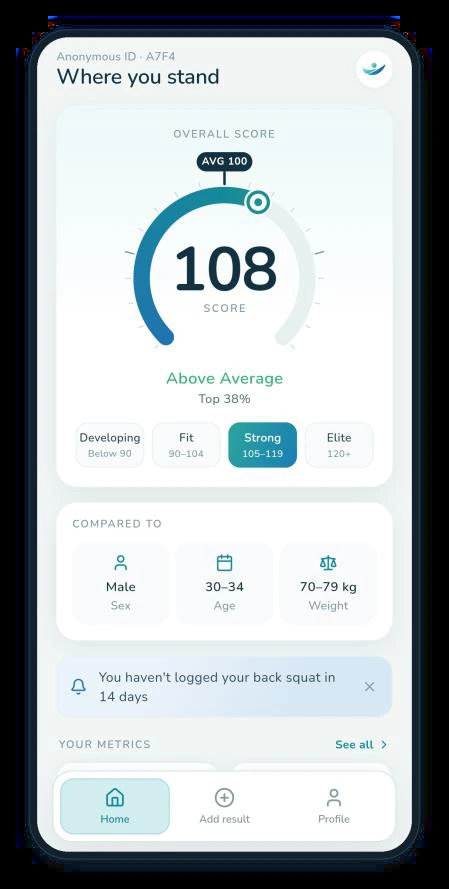
The actual individual prototype: a sample fitness score of 108, compared with a cohort defined by age, sex and weight.
Actual prototype screen with sample data.
The group view is an illustration of the planned product.

For the person“How am I doing, for someone like me?”

For the organisation“What is changing across our people?”

The gap we are building for

The facts tell
part of the story.

An organisation can know everything about an incident, a deployment or a demanding period of work, and still know very little about its human impact.

My LIMEN’s vision connects two needs: useful context for the individual, and a current, protected understanding of the group.

  1. 01

    The event is recorded.

    Timings, actions and outcomes capture what happened.

  2. 02

    The experience continues.

    People carry the demand, the recovery and the effect on their lives.

  3. 03

    Understanding needs context.

    A personal benchmark or a protected group trend can offer another perspective.

The individual experience

Progress with context.
On your own terms.

Compare a result with a relevant cohort and follow your own direction. Fitness is the first use case; the wider vision includes readiness and wellbeing.

  • Private benchmarks and personal trends.
  • Value returned to the person taking part.
  • An intended experience without public profiles or leaderboards.
See the individual prototype

The planned organisational layer

See the pattern.
Protect the person.

Choose the questions, metrics and cohorts that matter in your setting. Build a view that updates as responses arrive, within privacy and data-quality rules.

  • Configurable measures and input frequency.
  • Participation alongside protected group results.
  • Group-level changes that may warrant attention.
Explore My LIMEN Professional

Something you can explore today

See the idea
taking shape.

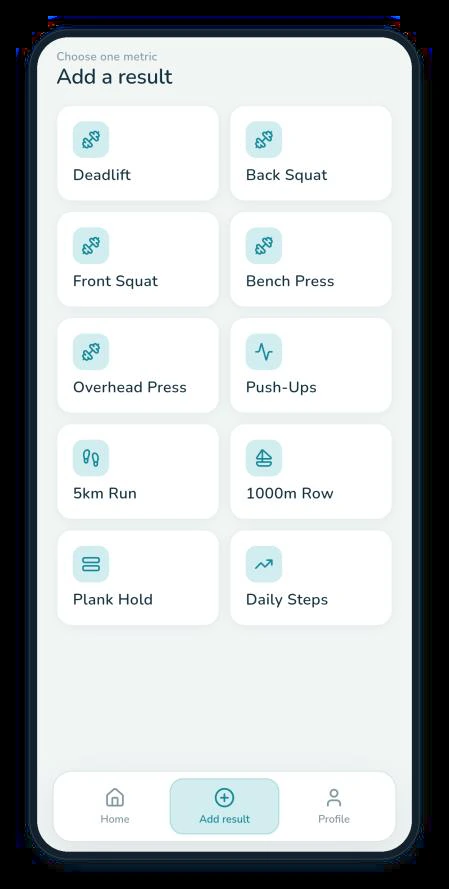
The hosted prototype demonstrates the individual experience: entering a result, exploring a benchmark and seeing the comparison cohort.

Available to explore · Demonstration data

Prototype home screen showing a sample score of 108 and its comparison cohort.
Where you standYour result, with context.
Prototype entry screen showing the ten fitness metrics available in the demonstration.
Log a resultTen metrics in the prototype.

Try the individual prototype

A closer look
is one tap away.

Open the prototype (opens in a new tab)
QR code from the investor deck, linking to https://my-limen.web.app/.

Prefer your phone?
Scan the deck’s QR code
with your camera.my-limen.web.app

The prototype uses demonstration screens and sample data. The consumer product and Professional platform are in development.

100 is a reference point.

The average for a comparable cohort, where suitable evidence exists. A score provides context; it is not a pass mark or a health assessment. Labels depend on the metric and its evidence.

My LIMEN Professional · Planned

One platform.
Your organisation’s context.

Readiness after a deployment. Belonging during a university term. Recovery across a training block. Each setting asks different questions.

The planned Professional product lets organisations configure their own view, while the privacy floor and measurement rules remain protected.

01 / 03

Put the group
picture in context.

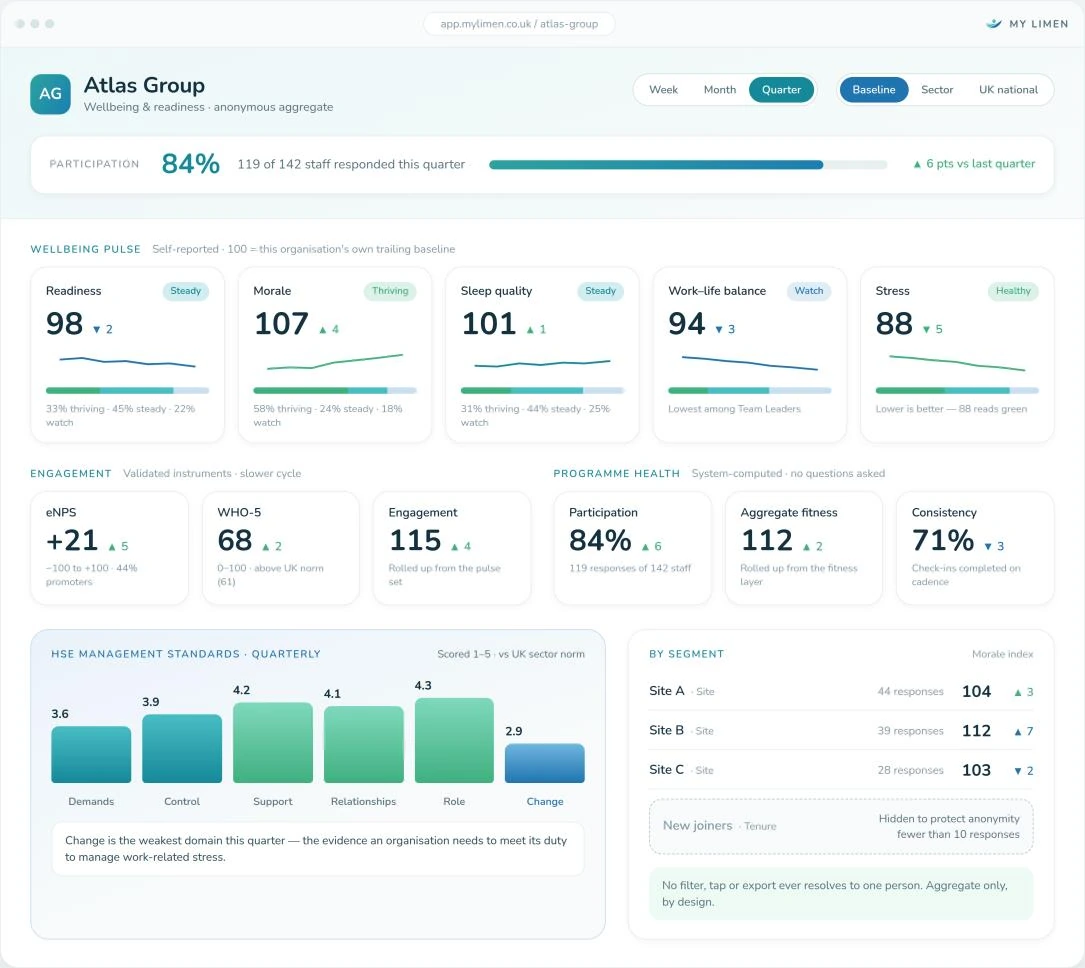
Bring trends, participation and permitted cohort comparisons into one view. A result is more useful when you can see how many people contributed.

  • Readiness, morale, recovery and other relevant measures.
  • Self-reported, validated and computed measures distinguished.
  • Results withheld when privacy rules are not met.

Planned product design from the deck. “Atlas Group” and all displayed data are fictional.

Planned Atlas Group dashboard showing participation, group wellbeing trends and a suppressed cohort.
Group dashboard concept Open image at full size ↗
02 / 03

Configure what
matters to your setting.

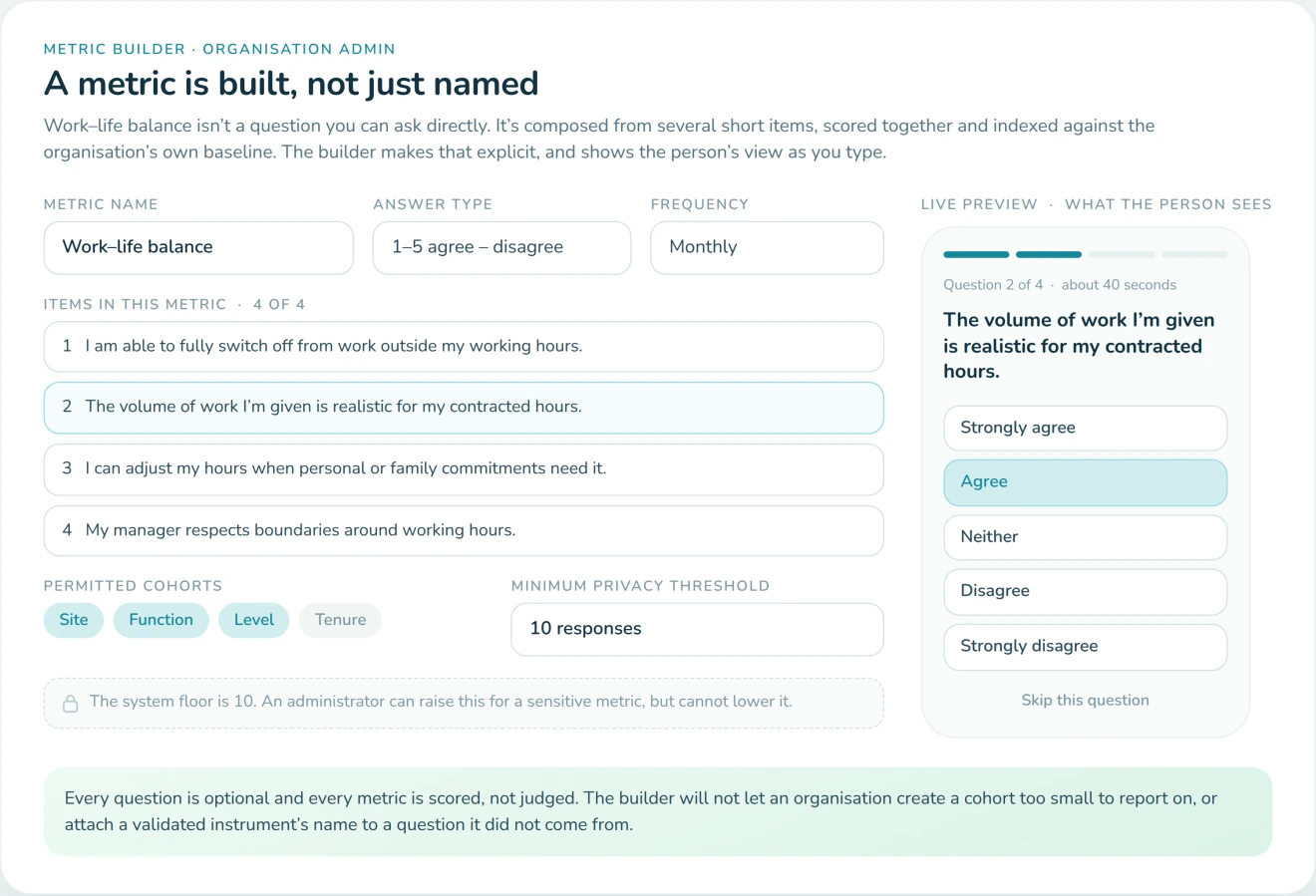
Build metrics and questions, choose the input frequency, and set permitted cohorts. Configuration operates inside the platform’s safeguards.

  • A privacy threshold above the system floor.
  • A preview of the question the person actually sees.
  • Local questions clearly distinguished from validated instruments.

A deadlift is entered directly. A work–life balance measure may combine several short items, scored together. Thresholds work alongside safeguards for filters, timings and exports.

Planned metric builder with a four-question work–life balance measure, an answer preview and a locked minimum privacy floor.
Metric builder concept Open image at full size ↗
03 / 03

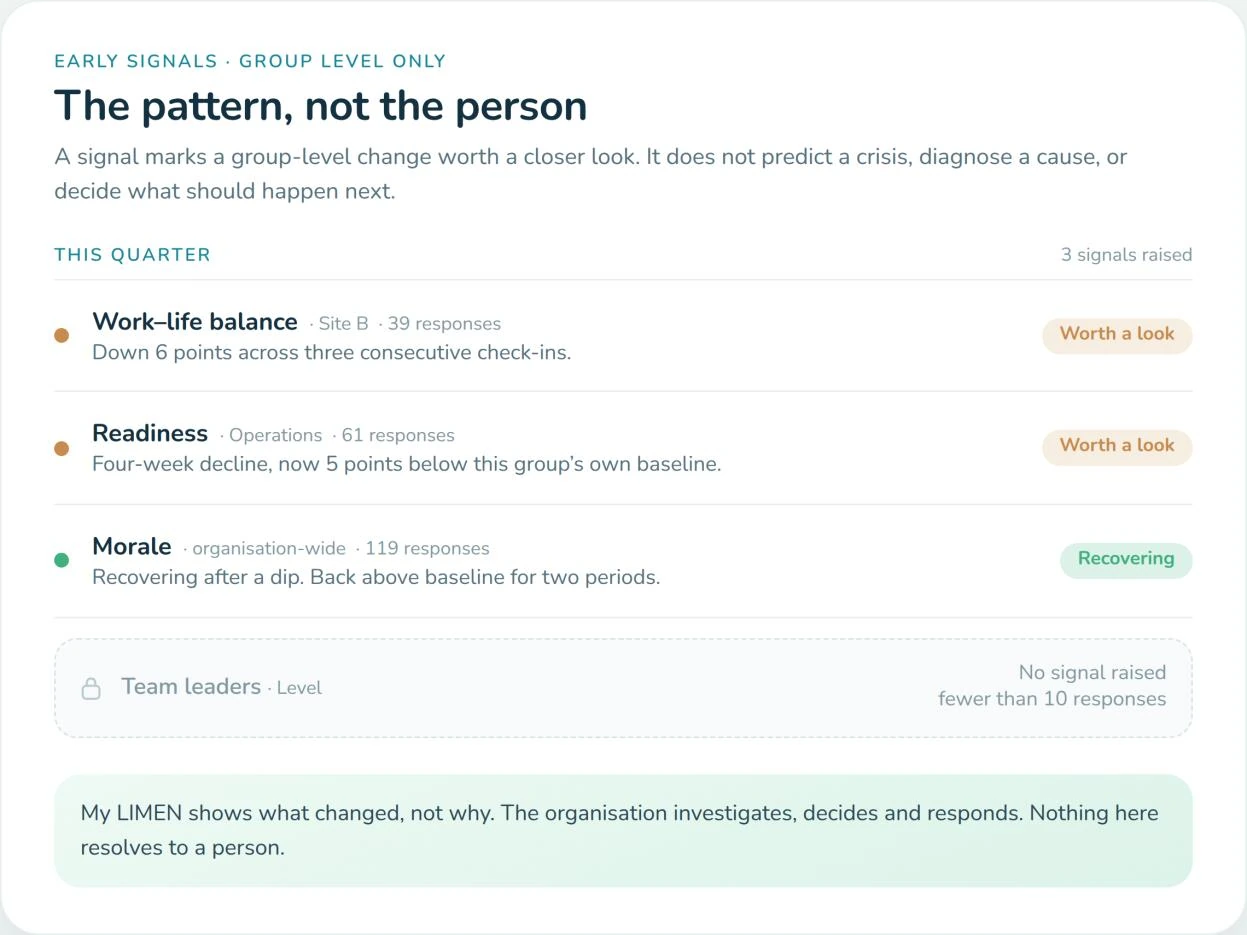
Notice a change.
Ask a better question.

A sufficiently large or sustained group-level change may warrant a closer look. The intended signal points to what changed, leaving interpretation and response with the organisation.

  • Signals only where privacy rules permit a group result.
  • Changes understood against the group’s context.
  • Professional judgement remains essential.

Signals do not identify individuals, diagnose a cause or predict a crisis. This screen illustrates the planned model with fictional data.

Planned early signal screen showing group-level work–life balance, readiness and morale changes, plus a withheld result for a small cohort.
Early signals concept Open image at full size ↗

Continuously updated means the view refreshes when responses arrive. It does not mean people are measured continuously, or that every change can be explained.

The human impact

Record what happened.
Understand what it took.

A demanding event can have a strong effect without that effect being entirely negative. The planned post-event check-in asks about strength and direction separately.

Brief, voluntary questions could help people reflect and give organisations a protected picture of the shared experience.

Incidents & deploymentsExams & placementsTraining & sustained pressure

Optional participation. Every question can be skipped. Non-diagnostic by design.

Planned post-event check-in
01 · Strength

How much has this event affected you?

  • Not at all
  • A little
  • Quite a lot
  • A great deal
02 · Direction

Has the effect been mainly…

  • Positive
  • Mixed
  • Negative
Illustrative preview of the planned experience.
No answers are collected on this page.

Trust before growth

Privacy shapes
the whole system.

The intended model keeps individual responses out of the organisation’s view. Protection also governs which group results can be released, and how they can be combined.

These are principles guiding development. The architecture and its safeguards must be evaluated before deployment.

  1. 01

    Protected group results.

    Aggregated patterns, with no individual answers or lists of who did or did not respond.

  2. 02

    A small group can mean no result.

    Minimum thresholds are one layer of protection. Group size alone cannot guarantee anonymity.

  3. 03

    The boundary follows the data.

    Filters, timings, exports and combinations of results need protection too.

Protected group viewIllustration
Group AAggregate insight available
Group BAggregate insight available
Smaller cohortResult withheld

Sometimes the responsible outcome is to show no result.

Fictional groups illustrating the intended privacy model.
The lines we will not crossRead the boundaries that shape My LIMEN.

From the manifesto’s commitments, carried into the deck. My LIMEN will never become:

  • A public leaderboard for human worth.
  • A surveillance system disguised as wellbeing.
  • A mechanism for identifying people who give uncomfortable answers.
  • A hidden employee dossier.
  • A platform where one organisation inherits another’s private history.
  • A route to recruitment, promotion, discipline or dismissal decisions.
  • A diagnostic service pretending to know more than it does.
  • A business that sells individual user data.
  • A system where deletion is only cosmetic.
  • A tool for punishing teams because their scores are inconvenient.

“Sometimes the most responsible thing a data platform can say is: we do not need to know that.”

The person behind the question

Kevin O’Mahony

Founder · Quiet Forge Ltd

Former Irish Naval Service.
Full-time firefighter.

Built by the person
who needed it.

“How am I really doing,
for someone like me?”

My LIMEN began with Kevin’s search for meaningful comparison without public exposure. A gym whiteboard could show everyone’s lifts, times and scores. It could not show what those results had taken.

His frontline experience brought a second perspective: organisations can record demanding work in detail while understanding much less about its effect on the people involved.

Those two experiences shaped the idea: give people useful insight into their own progress, and help organisations understand changing group patterns while protecting individual responses.

“Appearance is not capability.
Visibility is not truth.”

A founding principle of My LIMEN

Experience shaped the idea. Independent evaluation will test its usefulness.

Where we are going

Move from prototype
to evidence.

An individual prototype has been built with Foresight Mobile, the technical delivery partner behind the prototype and App Gameplan.

The next step is a consumer product and structured evaluation. The organisational layer follows when a pilot is agreed.

  1. Available

    Individual prototype

    Explore the personal benchmark experience through the hosted demonstration.

  2. Next stage

    Product & research

    Build the consumer product and evaluate trust, engagement, benchmark understanding and repeat participation.

  3. Planned

    Professional pilot

    Test the complete organisational loop in one focused setting, before exploring a second environment.

The planned business model

One platform.
Three levels of access.

Personal value and organisational understanding are part of the same vision.

Essential Free at launch
An introduction to selected metrics, basic scoring and limited trends.
Performance Paid personal subscription
A wider metric library, deeper benchmarking and longer personal trends.
Professional Organisation-funded
Custom measures, protected group insight and implementation support. Performance is included for participating members.

The next chapter

Help turn a clear idea
into a useful platform.

We’re looking for thoughtful partners to help develop, evaluate and responsibly introduce My LIMEN.

01 / Business & pilots

Build the opportunity.

For prospective investors, strategic partners and organisations interested in a focused pilot.

  • Explore the product direction and planned business model.
  • Identify a setting where the human-impact gap matters.
  • Discuss what a useful, responsible pilot would involve.
Discuss a partnership

Opens an email to Kevin.

02 / Research

Test the important questions.

For university and research partners interested in independent evaluation, ethics oversight and publishable findings.

  • Do people trust the privacy model and keep taking part?
  • Do they understand what their benchmark means?
  • Does personal value support engagement and perceived candour?
Discuss research

Opens an email to Kevin.

Evaluation should be able to challenge the idea and publish findings that do not flatter the product.

Request the presentation deck

A little more context

Good questions
deserve clear answers.

Is My LIMEN just for fitness?

Fitness is the first use case. The wider platform is being developed around private personal insight and protected organisational understanding across performance, readiness and wellbeing. Different measures need different questions, benchmarks and safeguards.

Does privacy guarantee honest answers?

No. Privacy is a founding commitment. Whether the model supports trust, perceived candour and consistent engagement is a research question to test, alongside limitations such as self-reporting and participation bias.

What does an organisational signal tell you?

In the planned model, it shows that something has changed across a group large enough to report on safely. It cannot identify a person, determine the cause, diagnose a condition or predict a crisis. The organisation remains responsible for interpreting and responding to the signal.

What can I try today?

The individual prototype (opens in a new tab) is available with demonstration data. It is separate from the consumer product and the planned Professional platform. You can explore this landing page without an account.

Start a conversation

Better understanding
starts here.

kevin@mylimen.co.uk

Tell Kevin about your setting,
your question, or the opportunity you see.